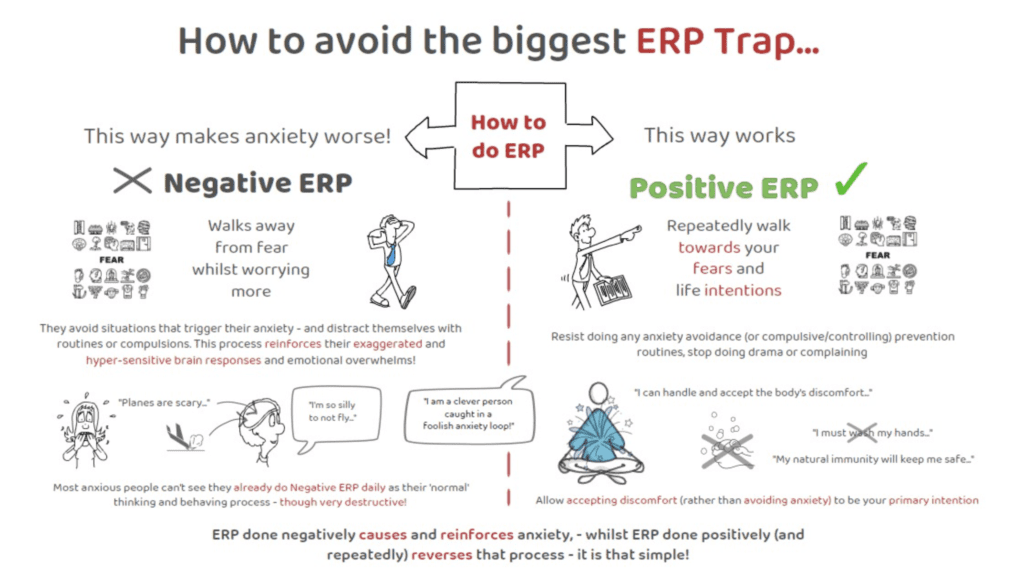
ERP works, and if you are not doing it, this is self-sabotage; and if you are doing it and it is not working, then you are simply doing it wrong!
My course deeply explains what ERP is, why you do it, and how to do it.
Put simply, it is by walking towards your fears that they become normalised in your brain (so the story of the fear changes) and with repetition, your body becomes desensitised to that fear.
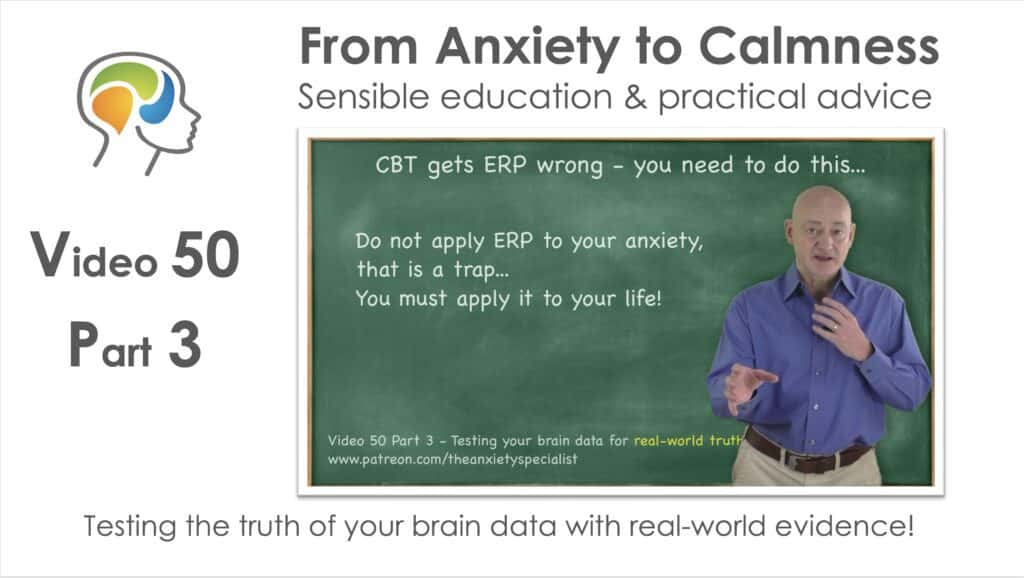
Using iStory ERP - Exposure & Response Prevention on your Life!
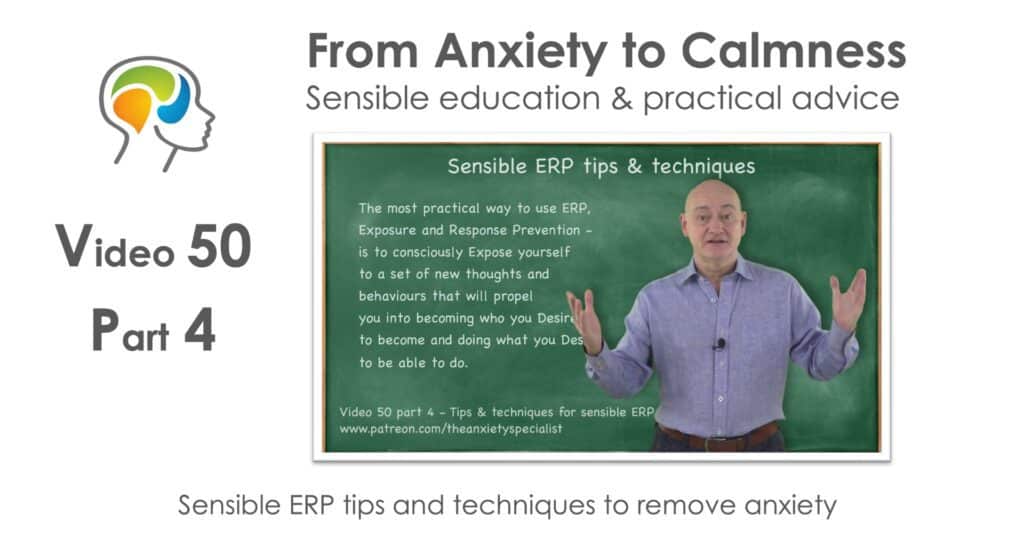

Sadly, you must start this from a place of fear and exhaustion, but if not now, then when?
It is effective for everyone, though those with brain configurations like autism or ADHD won’t be able to ERP the mechanism of their brain, but they can modify responses to their core behaviours.
For example: Though a person with ADHD may have time blindness, they can use Exposure and Response Prevention to accept and let go of feeling guilty about it.
Regarding anxiety, OCD and depression, this approach is effective if the individual understands the reasoning behind it, as anxiety often tries to sabotage progress, unless the individual is held accountable for practising it consistently over one or two months.
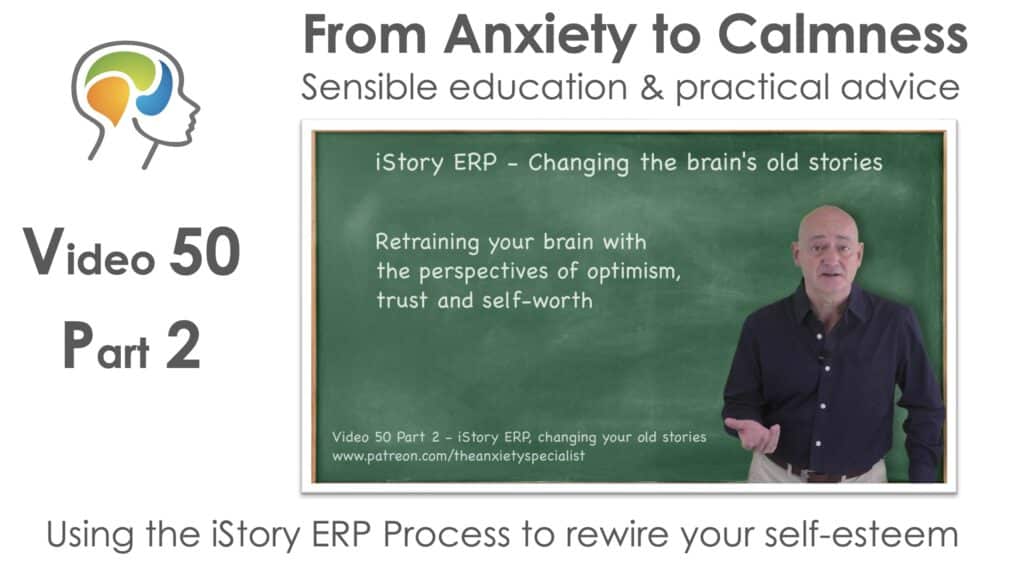
In a nutshell, if someone could consciously retrain their unconscious brain to change its existing conditioned attitudes from being:
Doubtful, Fearful and Pessimistic
to
Trusting, Courageous and Optimistic
they would likely feel better, regardless of the truth of any given situation.
Instead of thinking “Oh no, what if we get burgled?” they might consider “We have insurance, so we can replace our belongings.” While that may seem trivial, it illustrates the difference between living with worry and living without it.
Most anxious people tend to be anxious because they overthink and doubt, which can exhaust their bodies, and that fatigue sits behind the triggers for anxiety, depression and illness via mitochondrial distress.
So a common-sense question an anxious person might ask is:
“How were the brains of calm people conditioned to think during their childhoods?”
And if you are smart, you will ponder how you can consciously copy those thinking patterns and repeat them over and over until your unconscious brain adopts those programs, which we call attitudes.
This is how and why ERP works: it requires continual practice and repetition.
Think of it like learning to play the piano. You need to sit down at the piano repeatedly, practising again and again, even when you feel bored or uncomfortable. You ignore the discomfort of the body and the unhelpful thoughts of your brain, place your conscious awareness and desire on your intention to learn how to play, and then, after a year of repetition, you can luckily play the piano.
Mainstream psychology and medication often concentrate on treating the DSM-5 symptoms of anxiety, assigning labels such as OCD, bipolar disorder and Pure O. This approach tends to overlook the opportunity to help individuals explore the underlying causes of their anxiety.
These causes often stem from unresolved childhood trauma, biological exhaustion, self-consciousness, low self-esteem and self-worth, excessive thinking, and a lack of basic human needs being met, such as rest, good nutrition, social connection, love, sunlight, creativity and a sense of purpose.
When a person intentionally works to reprogram their unconscious mind with more optimistic and loving narratives, everything begins to change. This process is not easy; in fact, it can be hard and scary. However, it is a more useful type of hard and scary compared to what you may already be experiencing.
Both paths present their own challenges. One path confines you and limits your opportunities, while the other opens the door to new people, places, experiences and knowledge.
Knowledge is understanding something, while wisdom is the insight gained from applying that knowledge in real-life situations through ERP.
When a person engages in this work, something interesting happens: they start to feel a greater sense of control over their life. Their fearful thoughts begin to diminish as they come to understand that their happiness is their responsibility, no one else’s.
It is an inside job. It is a chosen attitude that can be consciously ERP’d into the unconscious brain if you consciously love yourself enough to do it.
This can be quite shocking for many people.
A large section of the population will scoff and reject what I am saying, and that is fine, because we must accept that naiveté and low intelligence are a curse for about half the population; and respectfully, if they could do better, they would.
Many naturally intelligent individuals, whether street-smart or academic, become so caught up in trying to understand everything and please others that they follow the crowd instead of their own true thoughts and feelings.
This leads to doubt, fear and exhaustion.
They may seem a bit different, but they are usually the ones who see things clearly. Sadly, their insights often conflict with what society expects, leading to a struggle that can cause disillusionment and fatigue as they try to balance being true to themselves and fitting in (being authentic feels way better).
Finally, there is a small group, my favourites, who are a bit more extroverted, creative, dominant, spontaneous, playful and live in the now. These ADHD and bipolar types need to embrace their quirkiness, their emotional connection to life, their creativity and spontaneity.
They can start asking themselves what new skills they might need to learn to re-engineer their brain to tell new, more optimistic stories and to help the body respond more calmly, so that, over time, the negative emotional load on the biology lessens and the energy slowly recharges.
Your emotional battery will gradually return to how nature intended it to be, not what your fearful, catastrophising, anxious and depressive brain, from childhood parental, school, culture or religion conditioning, made it into.
After a few months of this loving self-reprogramming, good things will begin to feel good again, so you will feel a little more motivated to take action. Bad things will feel uncomfortable, so you will take action to fix them, change your attitude to accept them, or move away from them.
You will be more able, if you have the right skills, to take more responsibility for your life experience. You cannot control the outcomes of any action you take, but you can control the choice to take that action.
Science indicates that organisms with a specific intention, and who take action based on that intention, observe the outcomes, and then adjust their strategies accordingly, consistently outperform those who only think about their intentions but never act. Avoiding something is not the same as addressing a genuine need.
Basically, they use a process to make decisions in their life: is this action in line with who I am trying to become and what I desire for my life? Yes or no?
And it has nothing to do with how the conditioned brain may be screaming or how the hypersensitive body is responding to the release of all those fear hormones from that fearful thinking.
Then comes the part that is even scarier.
If ERP is proven to work on the symptoms of anxiety, then applying it to your life itself might be even scarier, because you will have to answer four fundamental questions.
1. What type of man or woman do I wish to become?
2. What do I desire for my life?
3. What skills do I need to learn, despite my current situation?
4. How can I take action towards those self-defined intentions?
Skills for socialising, working, relationships, parenting, and more. In this way, what you are really saying to yourself is that you are taking responsibility for your life, and though it is scary, which can also feel like excitement on a rollercoaster- it is you choosing the path.
Which group are you in?